Gardeners seeking a peaceful retreat from the vibrant energy of warm-colored blooms are turning to cool-toned palettes, which emphasize blues, whites, silvers, and soft purples. Unlike the bold contrast of reds and yellows, these hues create a harmonious, calming effect that becomes especially striking in the soft light of evening. Building such a garden, however, requires careful attention to texture, height, and bloom timing to avoid a washed-out appearance.
Among the standout choices for a cool-toned garden is the 'White Swan' coneflower (Echinacea purpurea), a cultivar that swaps the typical pink-purple petals for a cooling white, with an orange-brown cone that adds warmth and prevents it from blending into other white flowers. Blooming from early summer through fall, this perennial tolerates drought and requires minimal care, making it a low-maintenance addition. Deadheading encourages more blooms, while leaving a few spent flowers provides seeds for birds.
For vertical interest, 'Blue Victory' salvia (Salvia farinacea) offers deep blue-purple spikes that reach about 20 inches tall, providing a rich backdrop for shorter plants. This salvia is heat-tolerant and low-maintenance, and cutting back spent spikes promotes additional flowering. Another vertical option is 'Shades of Blue' larkspur (Consolida regalis), an annual that can grow up to four feet tall, with flower spikes ranging from pale sky blue to deep purple-blue. Larkspur prefers cool weather and should be direct-sown in fall or early spring, as it does not transplant well.
Adding Movement and Fragrance
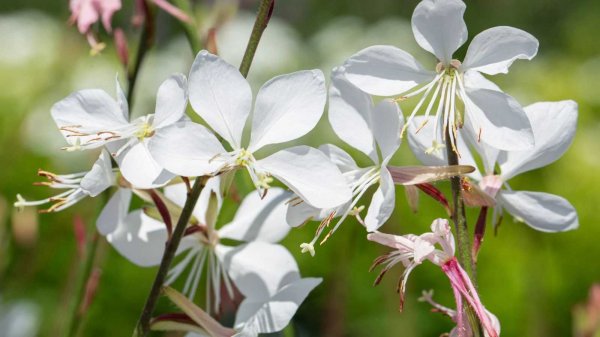
White gaura (Gaura lindheimeri) brings an airy, movement-filled quality to the garden, with delicate white flowers on thin stems that sway in the breeze. Growing up to 48 inches tall, this plant tolerates heat, drought, and poor soil, making it a versatile choice for middle-height layering. Similarly, 'Snowmaiden' scabiosa (Scabiosa atropurpurea) produces white pincushion-like blooms on long stems, ideal for cutting. This perennial attracts butterflies and bees and blooms from late spring through summer with regular deadheading.
Fragrance is another dimension to consider. 'High Scent' sweet pea (Lathyrus odoratus) is a climbing vine that reaches five feet and offers a strong scent, best enjoyed in the evening. Planting it near seating areas maximizes the olfactory experience. For a classic cool-toned fragrance, 'Vera' lavender (Lavandula angustifolia) provides purple-blue spikes above gray-green foliage, with a scent that intensifies on warm days. This hardy lavender tolerates colder winters and blooms in early to midsummer, with a possible second flush if spent flowers are cut back.
Foliage and Fillers
Silver foliage is essential for connecting cool-toned flowers. 'Silverdust' dusty miller (Jacobaea maritima) features finely cut, silvery-gray leaves that add textural contrast without competing for attention. Though a perennial in zones 8-11, it is often grown as an annual in cooler climates. For a low, spreading option, 'Tiny Tim' sweet alyssum (Lobularia maritima) forms compact clusters of white blooms that create a cloud-like effect along borders or container edges. This annual self-seeds readily and stays under six inches tall, softening hard edges.
Anise hyssop (Agastache foeniculum) is a perennial that produces lavender-blue spikes from midsummer through fall, attracting bees, butterflies, and hummingbirds. Its foliage emits a licorice scent when brushed, and leaving the spent spikes standing adds winter interest. For a unique cool-toned bloom, 'Amazing Grey' corn poppy (Papaver rhoeas) offers soft blue-gray, papery petals that are particularly striking when backlit by morning or evening sun. These annuals bloom in spring and fall, self-seeding reliably if some flowers are allowed to set seed.
By selecting a mix of these plants, gardeners can create a cool-toned garden that is both visually interesting and soothing, with a range of textures, heights, and bloom times that keep the space engaging throughout the growing season.