For gardeners in cold climates, the first signs of spring are often measured not by the calendar but by the emergence of hardy blooms. While tender annuals must wait, a select group of perennials and shrubs reliably flowers as early as January, providing color when the landscape is still mostly dormant. These 13 species, ranging from ground-hugging wildflowers to tall shrubs, offer a practical way to extend the garden season without risking frost damage.
Among the earliest to appear is the snowdrop (Galanthus nivalis), a bulb that often pushes through snow cover. Its drooping white flowers emit a light honey scent and attract early pollinators. For best results, plant bulbs in fall, burying them three to four inches deep when nighttime temperatures hover between 40-50°F (4-10°C), typically in September or October. Clusters spaced two to three inches apart create a naturalized look.
Crocus (Crocus spp.) are another late-winter staple, with tiny blooms in purple, yellow, and white emerging while snow remains. These perennials grow from corms that multiply over time. To prevent overcrowding, dig up and divide the corms every three to five years, replanting the offshoots in new spots. Allow the foliage to die back naturally after flowering to nourish the plant for the next season.
Shade-Loving Options for Early Color
For shaded areas, hellebores (Helleborus spp.), also known as Lenten roses, are a reliable choice. Blooming from late winter through mid-spring, they produce nodding flowers in shades of pink, purple, yellow, and white, some with double petals. These perennials prefer partial to full shade and well-draining soil that stays moderately moist. They gradually spread but rarely become invasive.
Lungwort (Pulmonaria spp.) is another shade-tolerant perennial, growing less than a foot tall and spreading by rhizomes. Its early spring flower stalks bear clusters of small, funnel-shaped blooms in pink, purple, or blue. The foliage, marked with white spots, provides interest through summer and fall, making it a good companion for hostas and foamflower.
Primroses (Primula spp.) also thrive in dappled light. The genus includes nearly 500 species, many blooming from early spring through summer. These low-growing plants form rosettes of oblong leaves and produce upright stalks with five-petaled flowers. They are short-lived perennials ideal for woodland edges.
Shrubs and Wildflowers for Sun or Part Shade
In sunnier spots, flowering quince (Chaenomeles speciosa) offers a profusion of small, round flowers in red, pink, coral, or white, all with yellow stamens. This shrub, native to temperate China, tolerates well-drained soil and can be pruned after flowering to keep it tidy. Winter jasmine (Jasminum nudiflorum) blooms as early as January, covering its woody stems with bright yellow flowers. It can be grown as a shrub or trailing vine, and pruning should be done in spring after flowering.
Witch hazel (Hamamelis spp.) includes species that bloom in late fall or early winter, such as common witch hazel (H. virginiana), and others like vernal witch hazel (H. vernalis) that flower in late winter. Their elongated petals give the branches a spider-like appearance, with colors ranging from yellow to red and pink. Potted plants are easiest to establish, transplanting in spring or fall when temperatures are cool.
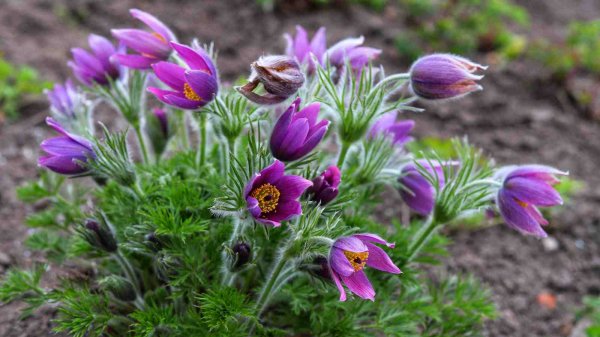
Among wildflowers, spring beauty (Claytonia virginica) is one of the first to appear in eastern US forests, with small white petals striped with pink. Pasque flower (Pulsatilla spp.) blooms before its leaves emerge, producing purple or white flowers atop short stems; many species tolerate temperatures well below freezing, making them suitable for northern states like Montana and Minnesota. Moss phlox (Phlox subulata), also called creeping phlox, forms low carpets of pink, purple, or white flowers, thriving in well-drained, even sandy, soils.
Violas (Viola spp.), including pansies and Johnny-jump-ups, are cool-season favorites with edible flowers. They bloom in late winter and early spring, and regular deadheading encourages more blooms. Daffodils (Narcissus spp.) are iconic spring bulbs, with trumpet-shaped flowers in a range of colors and forms, from double petals to frilled coronas.
For gardeners eager to see color before the official start of spring, these 13 species provide a dependable palette. Each has specific sun, soil, and hardiness requirements, but all share the ability to brighten the garden when it needs it most.