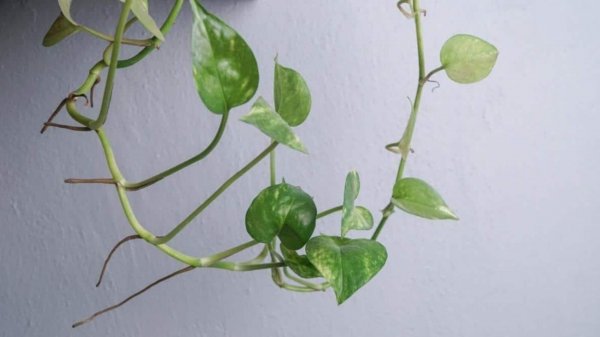
Pothos, often called Devil’s Ivy, is a favorite among indoor gardeners for its adaptability and ease of care. But even these hardy natives of the Solomon Islands can lose their leaves, leaving behind long, bare vines that look more like tangled string than a lush houseplant. When a pothos starts dropping foliage, it’s usually a signal that something in its environment is off. The good news: most causes are straightforward to correct, and the plant typically bounces back with a little attention.
Five factors account for most cases of leafless pothos vines: insufficient light, lack of pruning, overwatering, nutrient deficiencies, and pest infestations. These issues often lead to a “leggy” appearance, where vines stretch out with wide gaps between leaves. Understanding which problem you’re dealing with is the first step toward restoring your plant’s health.
Light: The Most Common Culprit
Pothos are known for tolerating low light, but that doesn’t mean they can thrive in darkness. A common mistake is assuming they can survive on a sliver of light from a small window or a desk lamp. In reality, pothos need bright, indirect sunlight for 4–8 hours a day. When light is scarce, the plant stretches toward the nearest source, resulting in long, spindly vines with few leaves. You may also notice the leaf nodes—those small brownish bumps along the stem—spacing farther apart than usual. This is a clear sign of light deficiency.
The fix is simple: move the plant closer to a window, ideally one facing north or east, or place it a few feet away from a south-facing window to avoid harsh direct sun, which can scorch the leaves. If natural light is limited, a basic LED grow light can supplement. After relocating, give the plant about a month to show improvement. Misting the nodes can encourage new leaf growth along the vine.
Pruning: A Counterintuitive Solution
Many plant owners hesitate to cut back their pothos, fearing it will harm the plant. But pruning is one of the most effective ways to promote fuller growth. When you trim the long, leafless vines, you remove the apical meristems—the growing tips at the ends—which redirects the plant’s energy into producing new leaves from the base. This results in a bushier, more attractive plant.
To prune, use clean scissors or garden pruners, sanitized with a diluted bleach solution. Make a clean cut just below a node, as close to the base as you like. For severely leggy plants, you can cut all vines back nearly to the soil, leaving only the shortest, leafiest stems. The plant will regenerate with proper light and water. The cuttings you remove can be used to propagate new pothos plants: place them in a jar of clean, non-chlorinated water with 2–3 lower nodes submerged. Roots typically form within 4–6 weeks, after which you can transplant them into potting mix.
Watering and Drainage: Finding the Balance
Overwatering is a frequent mistake with houseplants, and pothos are especially prone to root rot if left in soggy soil. Symptoms include droopy, yellowing leaves and bare vines. To check, stick your finger into the soil; if it feels wet or soggy, you’re watering too often. Pothos prefer to dry out between waterings.
If overwatering is the issue, repotting into a mix with better drainage can help. Use a pot slightly larger than the current one, with a drainage hole and a tray. A recommended soil blend is one part organic topsoil, one part compost, and one part perlite or vermiculite. When repotting, avoid compacting the soil to maintain air space around the roots. Water only when the top 2–3 inches of soil are dry, and water until liquid drains from the bottom, then stop.
Nutrients and Pests: Less Common but Important
Pothos are light feeders, but after months or years in the same pot, the soil can lose essential nutrients, leading to pale, yellowing leaves and stunted growth. A diluted liquid fish or kelp fertilizer applied once or twice a month can help. Alternatively, mixing compost or a slow-release granular fertilizer into the soil at repotting time provides a steady supply of minerals.
Pests are another possible cause of leaf drop. The most common offenders are mealybugs, scale insects, and spider mites. Mealybugs appear as small white fluff clusters under leaves or near nodes; they can be wiped away or sprayed with a diluted neem solution. Scale insects look like hard brown bumps on stems and must be scraped off gently, then treated with neem. Spider mites leave fine webbing and cause translucent spots on leaves; a strong spray of water from a hose can dislodge them.
While pothos are forgiving, they do need consistent care to stay lush. By addressing light, pruning, watering, nutrients, and pests, you can coax your vines back to their full, verdant glory. Patience is key—give your plant a few weeks to respond, and you’ll likely see new leaves emerging along those bare stems.